

Hello, and thank you for your interest.
I'm Neil, and Daruma is my project: a permaculture farm and the Mosaic Learning Centre school, sharing one campus an hour from Bangkok Airport (BKK). The same questions come up in nearly every email we get, so I've answered them here, honestly, before you plan anything.
The most important question: when?
We know people write to lots of hosts at once, usually because so many never reply.
So when you write back, please tell us whether you've decided or are still thinking. Either is fine; we just need to know which. We have a limited number of beds, and when someone holds dates and then quietly doesn't come, we've usually already said no to somebody else. If you're still thinking, don't lock in dates yet. When you're sure, say so clearly and we'll keep a bed for you. And if your plans change, a one-line email is all we ask.
There's no minimum notice. If you've just landed in Thailand and want to come tomorrow, ask; if there's space, we're happy to. What we can't really answer is "when is a good time to come?", because we try to run the programme all year. Give us one or two date options instead, and we'll tell you which works.
A few times a year the whole team travels or runs a big course, and we can't host volunteers. If your dates land on one of those, we'll tell you straight away and suggest other dates.
There's no fixed minimum stay. It does take a little while to settle in and for us to find the jobs that suit you, though, so the longer you can stay, the more you'll get out of it (and the more useful you'll be).
What will I actually do?
You stay and eat for free, so we do expect real work in return. If you don't have a particular skill or much experience yet, that's fine: you'll start with the everyday jobs that keep the farm and the campus running, and there are always plenty of those. If you do have experience that fits the farm (building, growing, cooking, fixing things), tell us, and we'll give you work around it.
You'll learn a lot just by being here and working alongside people who know what they're doing. The longer you stay and the more you get stuck in, the more projects open up to you, and the more interesting the work gets.
Interns are a bit different: longer stays and project-based work tied to skills they already have, so we'll want to talk that through properly with you first.
Want to go deeper? Do a course, then stay on
Volunteering is free; our courses are paid. A course gives you the in-depth part: focused teaching in one subject, like natural building or permaculture design, the theory behind why things are done the way they are, and a certificate at the end.
Then you can stay on as a volunteer and put it straight to work on our real projects. Finish the Natural Building Course, for example, and you can carry on with the building work going on around the farm. If you want to specialise and get proper, hands-on experience on the way to real expertise, that combination is hard to beat.
How much does it cost? Nothing.
Volunteering here is free. Years ago we asked for a small contribution, around 60 baht a day, and we stopped. We can afford not to charge, so we don't. Plenty of good projects in Thailand do charge a fair amount to cover their costs, and that's reasonable too. All we ask in return is that you take your time here seriously, because giving you a good stay takes effort on our side as well.
About the food
We don't grow everything we eat, and we're not trying to. Daruma's job is education, and we're happy to buy from the local market, the creamery down the road and the shops nearby. Spending money in your own neighbourhood is part of permaculture's "fair share" too.
We're not a vegetarian kitchen. Most meals include fish or meat, and there are always vegetables. Our kitchen is small and can't cook separate meals for different diets, so if you're vegetarian or vegan, the everyday menu on its own won't give you a balanced diet. What we can do is leave out things like fish sauce where possible, and give you space in the student kitchen to cook some of your own food. Tell us about your diet before you come, and we'll work it out together.
Work, hours & the 6:30 sweep
Our resident staff sweep the road at about 6:30 every morning. It's a residents' chore and nobody has to join, but I'd encourage it. We don't need your help with the sweeping itself. Sweeping together is a very Thai way to start the day, and it's how most volunteers get to know the staff. They get attached, too. Tears when a volunteer leaves are common here. This is a working community, and fitting in matters.
After that, the work depends on the season, the weather, which project comes first and, some days, whatever has just broken. We do listen to what you'd like to do, but the place has its own needs, so please keep that in mind when we plan the day.
We hope for five to six hours a day of careful work. Many people do more, and that's welcome, but we also want time for a board game or a trip to the beach at sunset. On hard days, in the heat, we understand working less. One piece of advice: don't try to keep up with our Thai staff. They work 8 to 5, six days a week, which is normal here. (And yes, some people ask to start at 5am to beat the heat. Sometimes that works, but most jobs need someone to direct them, or a team, so not always.)
Is there internet?
Yes, and it's pretty good, except when it's broken, which happens. There are computers you can use too.
One rule people find hard: no mobile phones in the school café. The children here see adults on screens all day, and we'd like to show them there's life away from one. The same goes for dinner, my own staff included, because that's when we actually talk to each other. A few managers need their phones for work. Everyone else, please try to spend less time online while you're here.
Smoking, drinking & cannabis
No smoking anywhere inside the campus. If you smoke, it's outside the gate, rain or not. I know that's annoying in the wet season.
A drink in the evening is fine, as long as you're still yourself and fit to work safely the next day. Cannabis is legal in Thailand for now, though the rules keep changing, and there are shops near the farm. We don't promote it. Children live and go to school here, and it still carries a stigma in Thailand, so please keep that in mind.
Can I rent a motorbike?
For volunteers, no. It comes down to insurance: we can't check yours, and if you have an accident while you're our guest, it can come back on us. Interns who can show proper insurance can talk to us about it. We lend bicycles for short trips, and for anything further, use Grab. It's cheap, it works well around here, and you'll want the app everywhere in Thailand.
What is there to do around Bang Phra?
Plenty, and it's easier to show you once you're here. Beaches, mangroves, islands, forest, lakes and hills are all close by. Sriracha is a great town with a large Japanese community, and Chonburi city has lovely old Thai-Chinese buildings. There's a good zoo (and a not so good one). Bangkok is about an hour and a half by bus. Pattaya is under an hour away; it has its reputation, but also plenty worth seeing and some very good restaurants. Koh Sichang, a small island off Sriracha, is a favourite day trip (but read the P.S.).
How do I get there?
It's easy, honestly. Let's settle your dates first, then we'll send directions that fit how you're travelling. If you can, arrive in daylight, early in the week.
The everyday details (where you'll sleep, laundry, what to bring, visas) live on our visitor policies & FAQ page, where we keep them up to date.
I hope this helps, and I hope we meet.
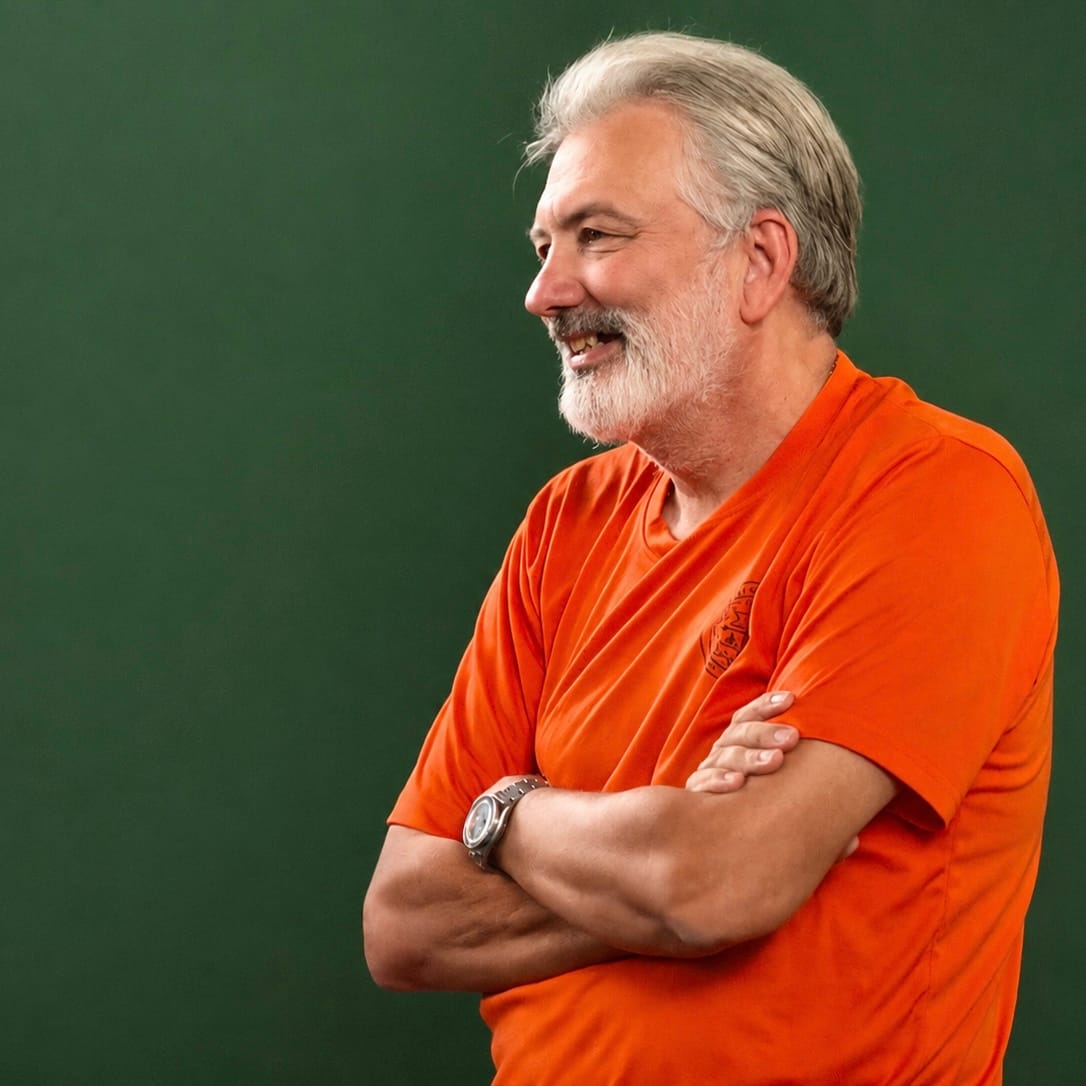
Neil Willmann
Founder, Daruma Eco Farm
P.S. Koh Sichang rents motorbikes very cheaply, and with so few cars it feels safe. Over 20 years, every one of our volunteers who rented one there has had an accident, usually poor brakes and gravel at the bottom of a hill. If you decide to do it anyway, please be careful.
How Daruma started
Daruma began more than 20 years ago as long-neglected farmland: flooded in the rains, burnt in the dry season, with worn-out soil. Using permaculture design and a run of animal systems (chickens, geese, ducks, guinea fowl, pigs and water buffalo), plus a great deal of planting, we slowly brought the soil back to life.
In those years we usually had 8 to 10 WWOOF volunteers at a time, put up most of the permanent buildings and ran Permaculture Design Courses and natural building courses. Education has always been the point (David Holmgren calls it the "education and culture" domain of permaculture). Around 2012 I took a university teaching post and the courses slowed, while Mosaic Learning Centre grew from 3 children into a school of more than 100. In 2020 we opened again for volunteers, and ran a few PDCs for travellers stranded by COVID. When Thailand was chosen to host the International Permaculture Convergence in 2026, a team came together to restart the courses and welcome volunteers again.