
Permaculture · A plain answer
What is permaculture?
Permaculture is a method for designing farms, homes and whole communities so they work with nature rather than against it. The name contracts ‘permanent’ and ‘agriculture’. Coined by Bill Mollison and David Holmgren in 1978, it rests on three ethics (earth care, people care, fair share) and a set of design principles, taught worldwide through the PDC.
A design system, not a single technique
Permaculture does not tell you to plant this or build that. It gives you a way of deciding what belongs where, and why, on any piece of land (including a balcony). The classic permaculture definition is Mollison’s own, from the Designers’ Manual: the conscious design of “agriculturally productive ecosystems which have the diversity, stability, and resilience of natural ecosystems.”
“The philosophy behind permaculture is one of working with, rather than against, nature; of protracted and thoughtful observation rather than protracted and thoughtless action.”Bill Mollison, Permaculture: A Designers’ Manual
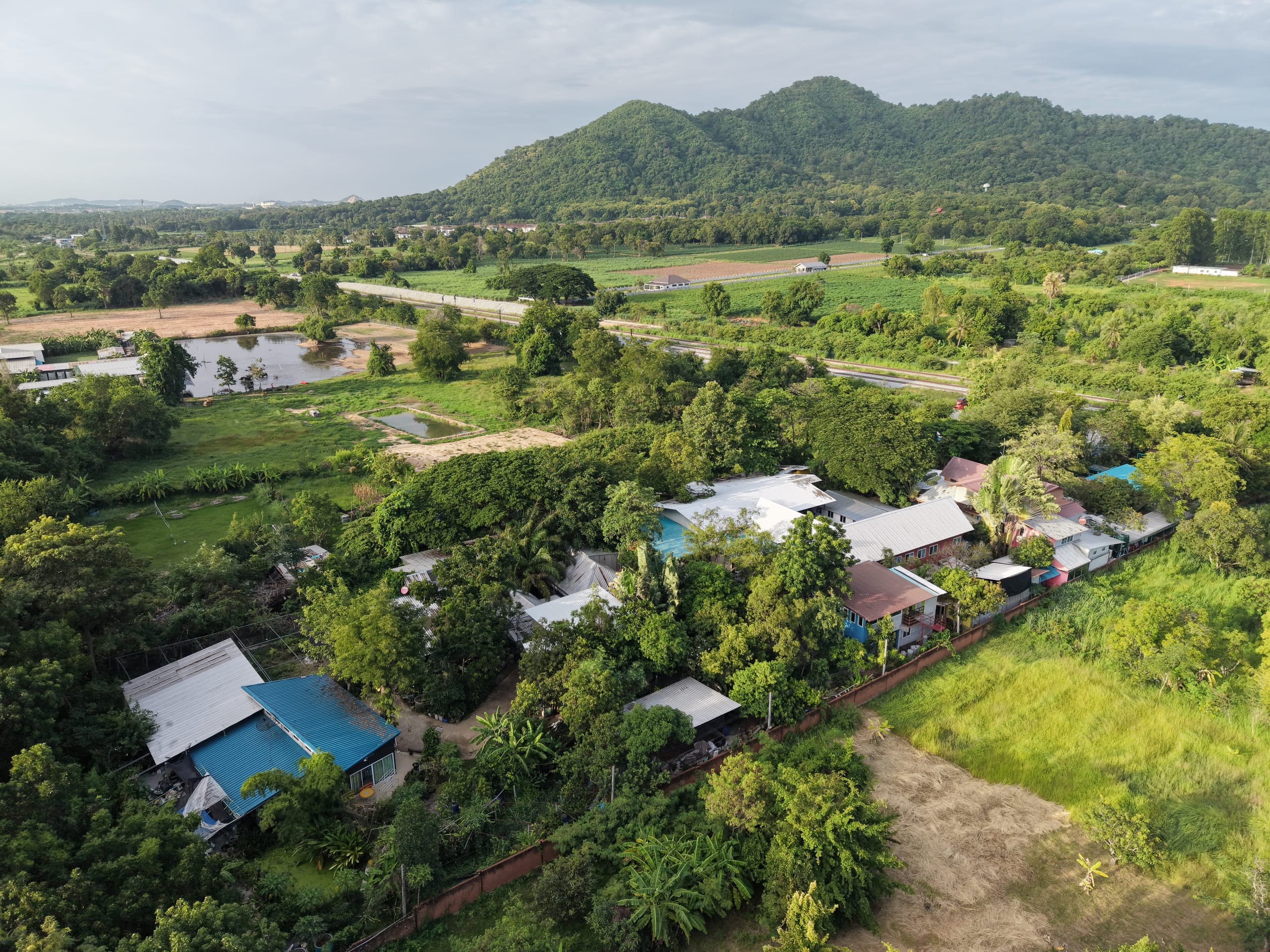
This page unpacks the definition the way we teach it at Daruma, an hour from Bangkok Airport (BKK): the meaning of the word, the ethics, the twelve principles, zones & sectors, and how the whole idea has kept evolving since 1978.
What permaculture means
What permaculture means: permanent agriculture to permanent culture.
The word is a portmanteau
Mollison & Holmgren built the word from ‘permanent’ and ‘agriculture’. In Permaculture One (1978) they introduced it as “a word we have coined for an integrated, evolving system of perennial or self-perpetuating plant and animal species useful to man.” Wordy, yes, but the key idea is in there: systems that keep going.
They were blunt about what made it different: “The fact that it is based on permanence serves to define it.” Annual crops feed you this season. Permaculture asks what will still be feeding you in thirty years.
Why it grew past farming
Farms turned out to be the easy part. A farm that lasts needs water systems, buildings, an economy and people who want to stay, so the design method kept absorbing more of life. Holmgren named the shift plainly in 2002: “the Permaculture vision of permanent (sustainable) agriculture has evolved to one of permanent (sustainable) culture.”
That is the meaning most teachers use today, ours included. Permanent culture: designing the whole human habitat, with food production as the anchor and everything else built around it.
“Permanent Agriculture: Is agriculture and animal management which improves the quality of land, provides income and produce, and is sustainable now and in the future.”A Resource Book for Permaculture (IDEP Foundation), the classroom gloss we use with students
The three permaculture ethics
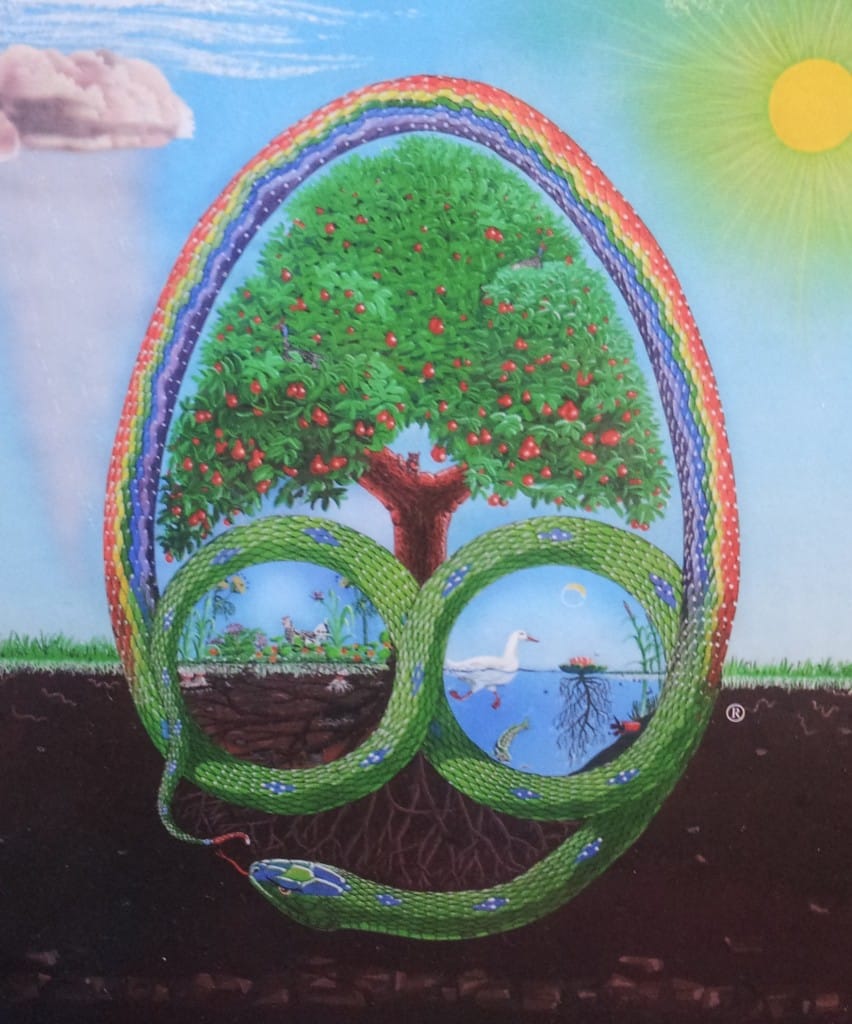
The three permaculture ethics guide every decision.
Permaculture ethics and principles form one code, and every design answers to it, whatever the zone, domain or field. Mollison didn’t invent the ethics: he wrote that “several of us researched community ethics, as adopted by older religious and cooperative groups, seeking for universal principles to guide our own actions,” then distilled what they found down to three.
“Provision for all life systems to continue and multiply” (Mollison). Regenerate the systems that support life.
“Provision for people to access those resources necessary to their existence.” Design for learning, dignity & community.
In Holmgren’s words: “set limits to consumption and reproduction, and redistribute surplus.”
“The Prime Directive of Permaculture: the only ethical decision is to take responsibility for our own existence and that of our children.”Bill Mollison, Permaculture: A Designers’ Manual
Why the third ethic has three names
Mollison first framed it as setting limits to population and consumption, later as “return of surplus.” Holmgren settled on “fair share.” The teacher Starhawk argues for “future care,” and the PINA curriculum splits it in two (fair share plus “limits aware”). The movement is still arguing, which we take as a healthy sign.
Rosemary Morrow points out that people care is the ethic with the fewest worked examples in permaculture teaching, so it is the one we lean on hardest here. On the ground in the tropics it looks like cooperatives, strong local economies and food sovereignty, the practical machinery that lets all three ethics actually happen.
The 12 permaculture principles
Holmgren’s twelve permaculture design principles.
Holmgren wrote that he organises “the diversity of permaculture thinking under twelve design principles.” Each one comes paired with a traditional proverb, because the ideas are older than the movement.
A note on the count before the list: there is no one official set. Different teachers keep different numbers of principles, and these twelve are specifically David Holmgren’s, from Permaculture: Principles and Pathways Beyond Sustainability (2002). They are the set most PDC courses teach worldwide, including ours. The first six work at the level of individual elements; the second six deal with patterns and relationships, and the twelfth loops you back to the first.
Principles 1 to 6 · working with elements
Design starts by watching, the way “animals survive and thrive by constantly observing” and interacting with their surroundings, as Holmgren puts it. A year of looking before building saves a decade of fixing.
The point is to set aside “surplus energy, food and other resources when they are available” and bank them: water in tanks and ponds, carbon in soil, fruit in preserving jars.
Idealism has to eat. “Without immediate and truly useful yields, whatever we design and develop will tend to wither,” Holmgren warns, so every element should pay its way early.
This one deals with the parts of a design that “limit or discourage inappropriate growth or behaviour.” Systems that punish overreach quietly, before the land does it loudly.
Renewables are the resources “renewed and replaced by natural processes over reasonable periods” without heavy fossil or mined inputs. Sunlight, timber, bamboo, animal work: spend the income, keep the capital.
Holmgren leans on Mollison’s definition of a pollutant: “an output of any system component that is not being used productively by any other component of the system.” Waste is a design fault, usually a fixable one.
Principles 7 to 12 · working with patterns
“Complex systems that work tend to evolve from simple ones that work,” so get the broad pattern right (zones, water, access) before fussing over which herb goes where.
Holmgren quotes Mollison directly here: place elements so that “each serves the needs and accepts the products of other elements.” Chickens under fruit trees; ducks in the rice paddy.
“Systems should be designed to perform functions at the smallest scale that is practical and energy-efficient,” with human scale as the yardstick. Small failures teach; big ones bankrupt.
Monocultures, Holmgren notes, are “a major cause of vulnerability to pests and diseases.” Diversity is the insurance policy: many species, many varieties, many income streams.
“Edges are dynamic and productive parts of all natural systems where exchange of materials and energy take place.” Pond margins, forest edges, the fence line: usually the busiest places on a site.
This principle “has two threads: designing to make use of change in a deliberate and co-operative way, and creatively responding” to the changes nobody controls. Which sends you back to principle one: observe.
The principle names and proverb pairings above are David Holmgren’s own, quoted from Essence of Permaculture (revised edition, 2020). Each proverb was chosen by him to emphasise “the negative or cautionary aspect of the principle.” The icons are ours; Holmgren draws his own set, and they are worth seeking out.
Mollison’s principles differ from Holmgren’s
There is no single canonical list, and that bothers newcomers more than it bothers teachers. Mollison never settled on one numbered set; his operational core was a pair of design maxims about function. Rosemary Morrow tells trainee teachers plainly: “Mollison has two or three; Holmgren has one set,” and she keeps her own. A discipline this young is allowed to keep several toolkits.
“Every component of a design should function in many ways. Every essential function should be supported by many components.”Bill Mollison, Permaculture: A Designers’ Manual
Site design
Permaculture zones & sectors.
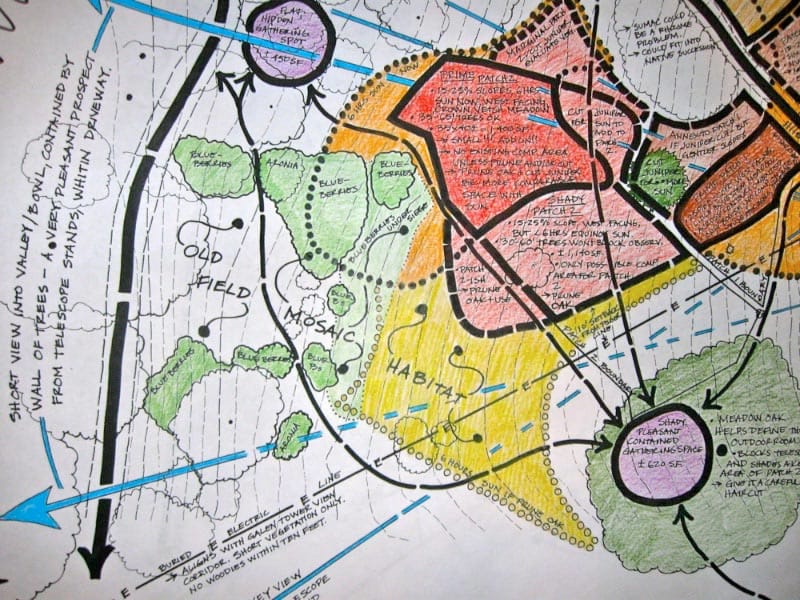
Zoning is the tool people usually meet first. Mollison called zone and sector analysis “a primary energy-conserving placement pattern for the whole site”: put the things you visit daily near the door, and the things that look after themselves further out. The idea is simple; applying it well takes practice.
Zones 0 to 5: placed by how often you visit
Hover or tap each ringWilder as you walk out
Every element in its place
Mollison’s rule is blunt: “We do not have endless time or energy, and the things we use most, or which need us often, must be close to hand.” He counts 460 trips a year to a poultry shed against two to an oak tree for acorns; the hens earn a place near the kitchen, and the oak can live far away. The perfect target diagram is meant to be deformed to fit real land, even bringing “wedges” of wilderness right up to the front door.
-
“The origin from which we work,” in Mollison’s words. Good house design belongs in this zone, along with everything that blurs the line between house and garden: an attached glasshouse or shadehouse, vines on trellis, pot plants, roof gardens, companion animals. In some climates the structures themselves are borrowed from the landscape (bamboo and rattan, thatch, wattle and daub) and will in time return to it.
-
Whatever needs continual observation lives here: fully mulched garden beds, culinary herbs, seedlings and young trees destined for the outer zones, the rainwater tank, and small quiet animals such as rabbits and pigeons. Within about 6 metres of a home, Mollison reckons, householders can produce most of the food necessary to existence. “In this zone, we arrange nature to serve our needs.”
-
Still visited most days, managed with a lighter hand. Spot-mulched home orchards, main-crop beds, terraces, hedges and small ponds sit here, and it is where the ranging domestic animals live (milk cows, goats, poultry), their sheds often backing onto zone 1 to keep the morning rounds short. Trees get less pruning; crops get more room.
-
The commercial zone: crops and animals raised “for sale or barter” rather than for the household table. It carries broadscale plantings, natural or lightly pruned trees, large water storages, barns and field shelters, and windbreak hedgerows. On a tropical smallholding this is coconut and jackfruit territory, staples that largely look after themselves once established.
-
Border country between farm and forest, still worked but only just: wild gathering, timber and fuelwood for the household, rough pasture, and hardy unpruned trees alongside volunteers that planted themselves. Water is stored in dams here and piped inward to the busier zones. You visit often enough to harvest, and seldom enough that the place mostly runs itself.
-
The natural, unmanaged end of the spectrum, entered for occasional foraging, for recreation, “or just let be.” Nothing here is planted or pruned. Mollison’s line about it doubles as the whole discipline’s method: “This is where we learn the rules that we try to apply elsewhere.”
Nobody is obliged to have all six. The Tropical Permaculture Guidebook is refreshingly direct about it: “in cities permaculture designs are mostly just zone one and sometimes zone two.” A balcony is a zone 1 with a view.
Sectors: the energies arriving from outside
“Our sectors are more site-specific than are the conceptualised zones.”Bill Mollison, Permaculture: A Designers’ Manual
Zones map your energy; sectors map everything arriving uninvited: sun paths, monsoon winds, flood water, fire risk. You draw them as a compass diagram over the real site, then place elements to catch what helps and block what harms. Zone-and-sector mapping is a core exercise on our PDC, and you can see the results laid out across our own land.

The permaculture flower
Seven domains of action.
Holmgren drew the permaculture flower to show, in his words, “the key domains that require transformation to create a sustainable culture.” The ethics and design principles sit at the centre; each petal is a whole territory of work, so there is far more here than any one farm covers. A spiral path winds through the petals, “initially at the personal and the local level, and then proceeding to the collective and global level.”
In RetroSuburbia he later contracted the seven down to three fields (Biological, Built and Behavioural) for everyday use. The best place to explore the full map is David Holmgren’s own flower, where each petal opens into its own discussion. Ours grows an hour from Bangkok; the education petal is the one we live in.
- 1Land & nature stewardship
- 2Building
- 3Tools & technology
- 4Education & culture
- 5Health & spiritual well-being
- 6Finances & economics
- 7Land tenure & community governance
How permaculture evolved
One word, five decades of rethinking.
Permaculture never sat still, and the person who changed it most was one of the people who invented it. David Holmgren wrote most of the original manuscript as a twenty-something student (Mollison, with the public profile, took lead billing) and he has been revising the idea ever since. The short version, in four books:
1978A name for a permanent agriculture
Permaculture One coins the word for “an integrated, evolving system of perennial or self-perpetuating plant and animal species useful to man.” The whole idea rests on permanence: systems designed to keep producing rather than be replanted every season.
1988Mollison fixes it to the land
The Designers’ Manual becomes the movement’s bible and pins the word firmly to “permanent agriculture”: consciously designed, agriculturally productive ecosystems with the diversity and resilience of natural ones. This is the book the 72-hour PDC is still structured around.
2002Holmgren widens it to culture
In Principles & Pathways, Holmgren declares the vision of permanent agriculture “has evolved to one of permanent (sustainable) culture,” then immediately concedes his own definition is “so global in its scope that its usefulness is reduced” and narrows the working sense to systems thinking and design principles. Rob Hopkins credits this book with putting permaculture “back on the map as a radical design science.”
2018Permaculture comes to the suburbs
RetroSuburbia takes the method somewhere Permaculture One never imagined: existing suburban houses, “the gateway to retrofitting your home, garden and life.” Holmgren even turns the tool on his own discipline, noting that permaculture design itself “needs a retrofit for the energy descent future.” Both books sit in our library, and the earlier ones are covered in our book reviews.
“Rather than seeking to define or control Permaculture, I write about it as simply one more contribution to understanding, meaning and action in a world full of uncertainty.”David Holmgren, Permaculture: Principles & Pathways Beyond Sustainability
Permaculture vs the rest
Permaculture is the design layer over organic & regenerative farming.
Holmgren has heard permaculture mistaken for a fancier sort of organic gardening often enough to answer it in print: “popularly seen as a ‘cool’ form of organic gardening, permaculture could be better described as a design system for resilient living and land use.” The distinction matters, so here it is properly.
The design layer, not a growing method
Permaculture, Holmgren writes, “is not the landscape, or even the skills of organic gardening, regenerative farming, energy efficient building or eco-village development. Rather, it can be used to design, establish, manage and improve these.” Organic methods, biodynamics, natural farming: all techniques the design layer can select and arrange. Toby Hemenway said the same thing from the city: a design approach that connects disciplines, rather than a discipline itself.
Regenerative agriculture is the close cousin. It shares the goals and many of the methods; permaculture contributes the whole-site design framework, regen-ag a fast-growing body of farm practice. Plenty of farms are both.
Rotation vs polyculture, and an honest weakness
Want one concrete difference you can see from the field edge? Patrick Whitefield: “Rotation, or diversity through time, is the backbone of organic farming and growing. But in permaculture we emphasise simultaneous diversity, with more than one kind of plant growing in the same field at the same time.”
And because trust is earned by admitting things: Eric Toensmeier, himself a permaculture author, notes the movement “has developed few if any new practices” and carries “a tendency toward distrust of and disconnection from science.” We teach that critique on the course, usually to the visible relief of the engineers in the room. Further reading on all three authors is in the book reviews.
“Permaculture is not a discipline in itself or a set of techniques but rather a design approach that connects different disciplines and makes use of a wealth of strategies and techniques.”Toby Hemenway, The Permaculture City
The people behind permaculture
Four voices worth knowing.
Permaculture has no head office, but it does have a lineage. These are the four authors we quote most on this page, and every book pictured here sits on a shelf at Daruma, usually with pencil marks in the margins.
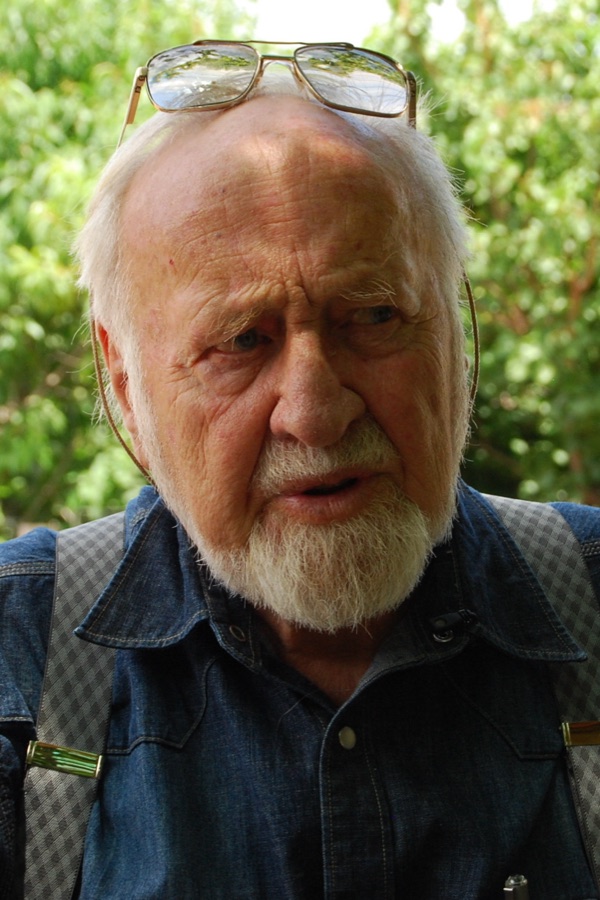
Bill Mollison
Co-originator · 1928 to 2016Raised in the fishing village of Stanley, Tasmania, in a household where “everything that we needed we made.” A University of Tasmania senior lecturer who turned observed natural systems into a teachable design framework; the first 26 students graduated in January 1981.
“Permaculture (permanent agriculture) is the conscious design and maintenance of agriculturally productive ecosystems which have the diversity, stability, and resilience of natural ecosystems.”A Designers’ Manual

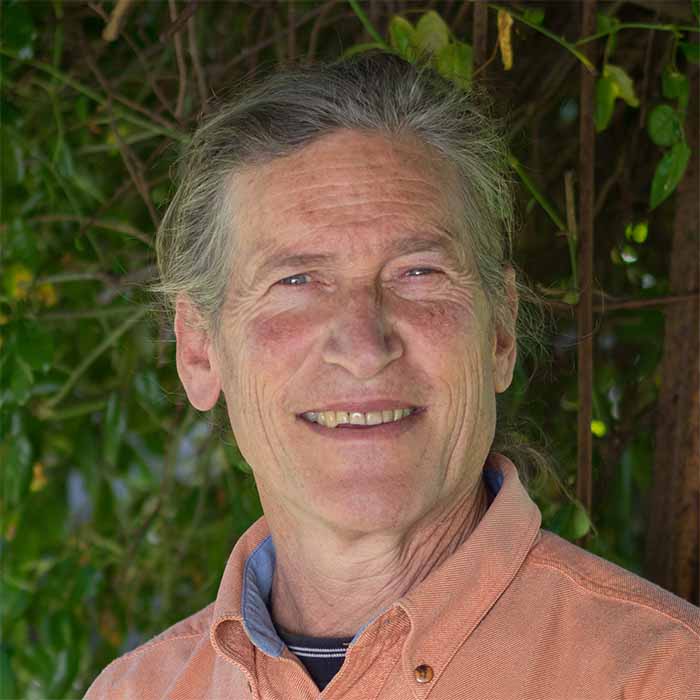
David Holmgren
Co-originatorHe met Mollison in 1974 as an Environmental Design student and wrote most of the Permaculture One manuscript; Mollison took lead billing for his public profile. Fifty years on, he is still the movement’s chief revisionist.
“Permaculture is much more than a form of organic gardening.”Principles & Pathways Beyond Sustainability
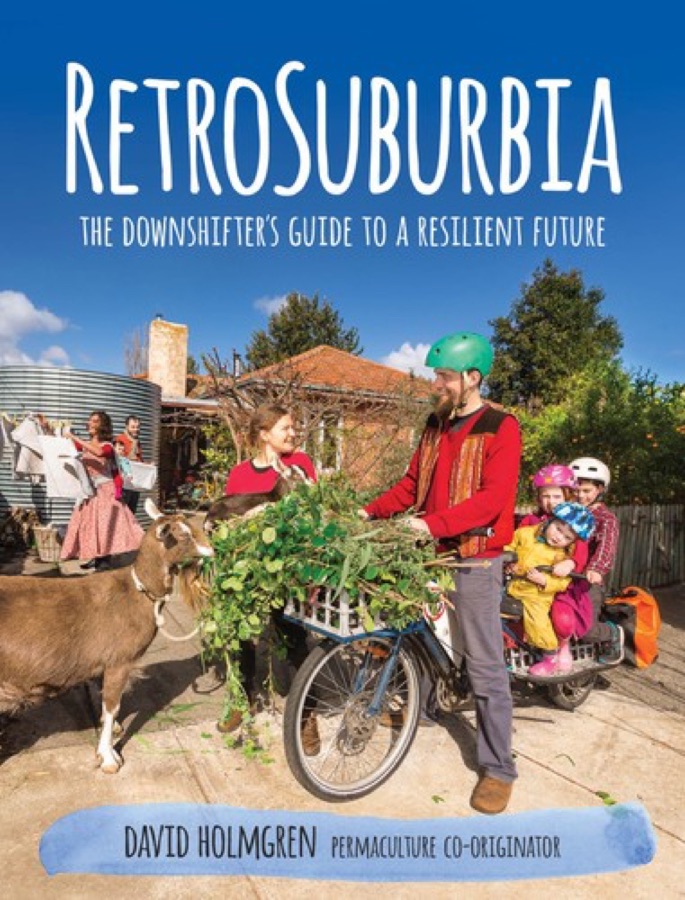 Principles & Pathways (2002) & RetroSuburbia (2018)
Rosemary Morrow
Teacher of teachersThe movement’s great educator, who has carried permaculture into Vietnam, Cambodia, Uganda and Afghanistan and argues that teaching teachers is the highest-leverage act in permaculture. Her life’s theme is the under-served second ethic: people care.
“For too long permaculture has been seen by too many as a simple system for creating organic gardens. This book is a recognition, and an assertion, that it can, and indeed must be, so much more.”Earth Restorer’s Guide to Permaculture
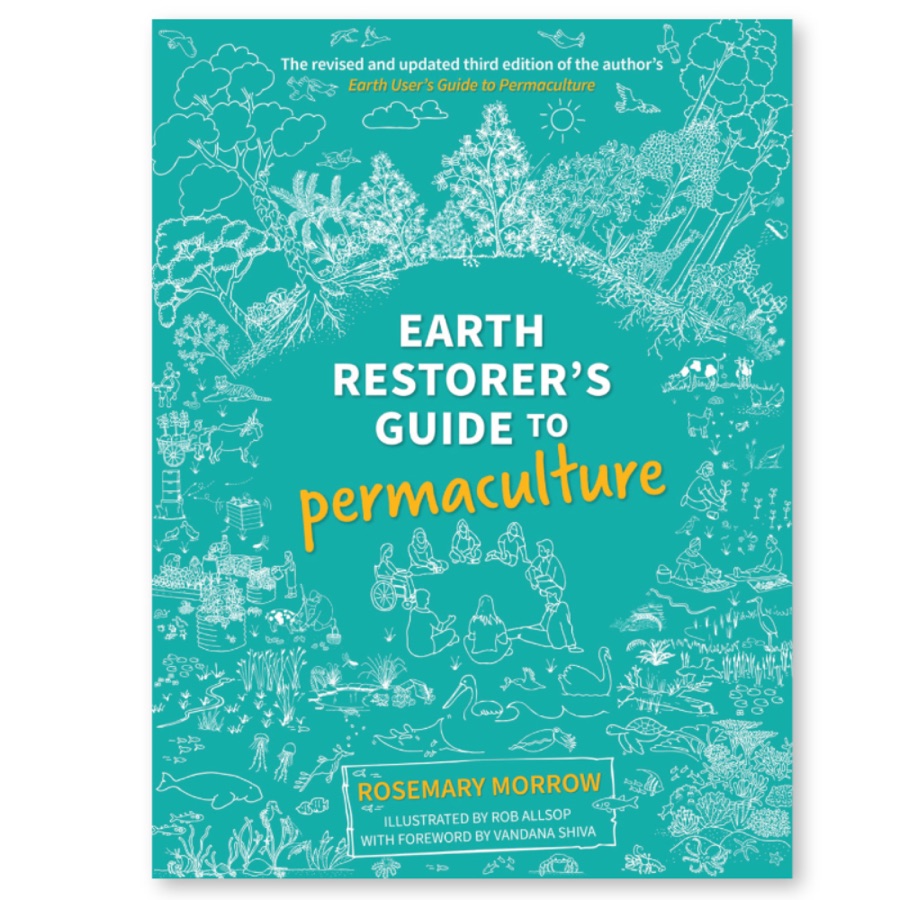 Earth Restorer’s Guide to Permaculture (2022)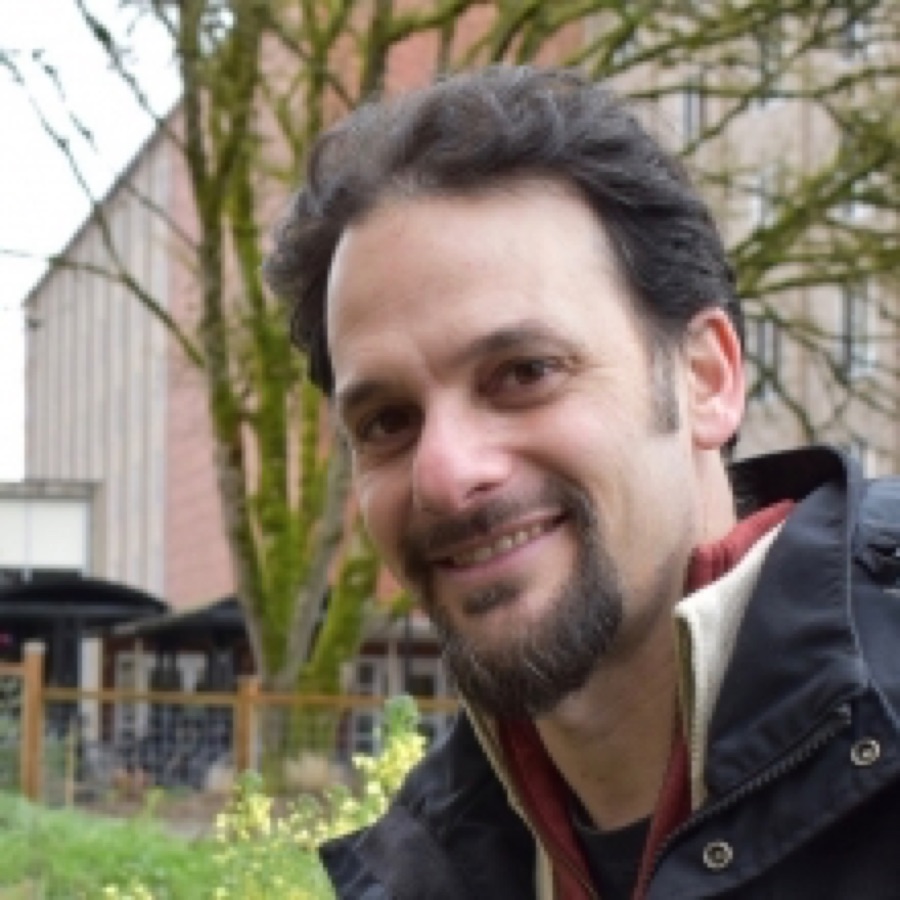
Andrew Millison
Second generation · Oregon State UniversityHis first design course was in 1996; he has taught permaculture at college level since 2001 and at Oregon State’s Horticulture Department since 2009. He founded Permaculture Design International in 2015, and his free permaculture course is published online by OSU.
“Our aim is to elevate permaculture design further into mainstream knowledge and discussions.”Introduction to Permaculture

All of these books, and about 1,600 others, live in the school library, open to students throughout their course.
New to permaculture? Start here
Design for Permaculture Living: a 2-day introduction
Taught in English and Thai side by side, this introduction to permaculture course covers systems thinking, the ethics and principles, and zoning over one weekend, a gentle first step before committing to the full PDC. From ฿3,000. An official IPC16 satellite event.
How to learn permaculture
The permaculture design course, and what comes after it.
The standard permaculture course is the PDC, “the standard 72-hour Permaculture Design Course” in the PINA curriculum’s words. Mollison built it deliberately as a teach-the-teachers machine, and it worked: Rosemary Morrow credits permaculture’s global spread to “the teachers - those who have taught the students who have become the teachers.”
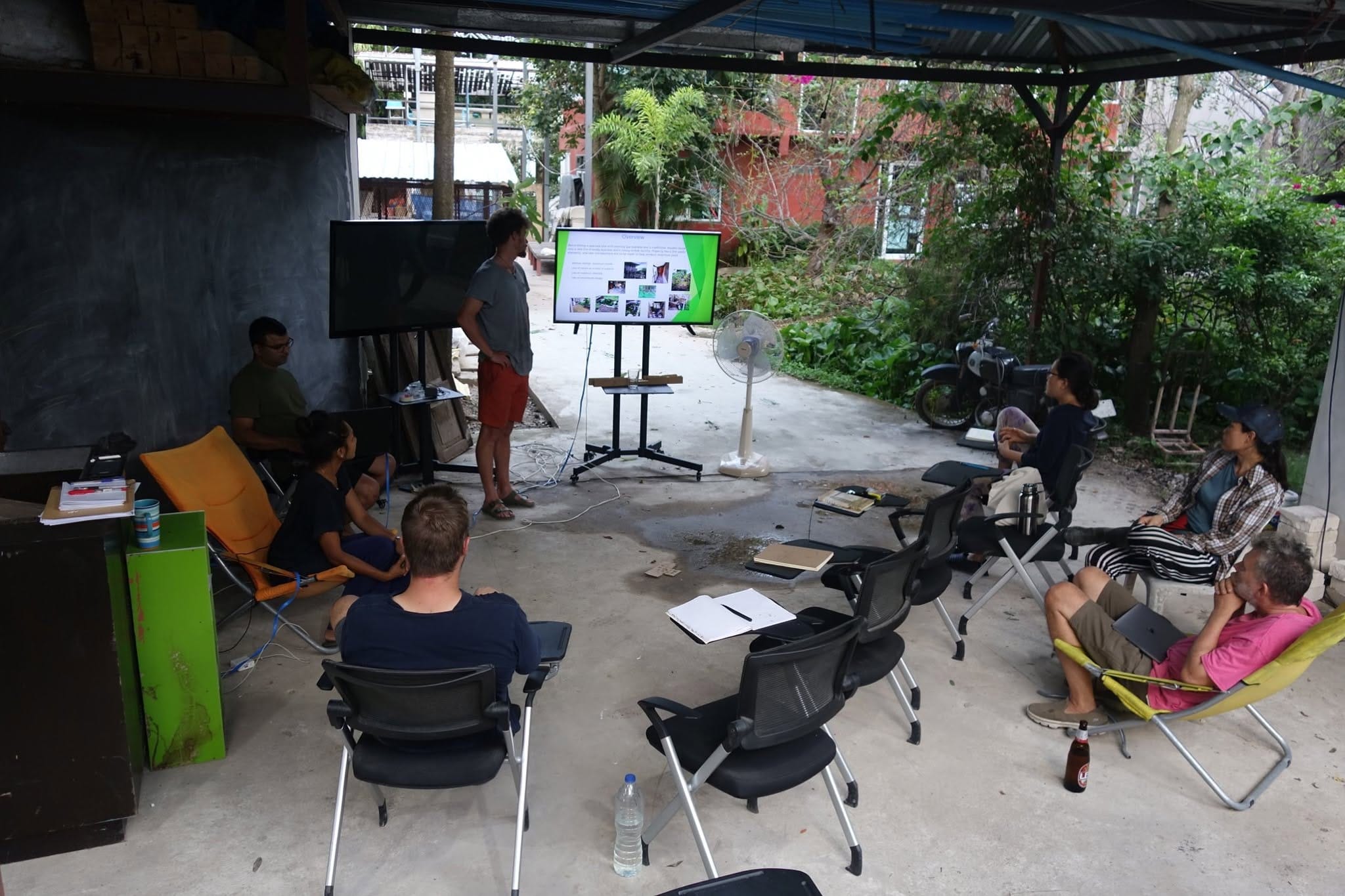
At Daruma Eco Farm we teach an internationally recognized Permaculture Design Certificate course on the full 72-hour-standard curriculum: Mollison’s framework, with Holmgren’s principles taught alongside, an hour from Bangkok Airport (BKK).
Worldwide, hundreds of thousands of designers have taken a PDC since the first course ran.
What the course covers
Sustainable living systems for a wide variety of landscapes and climates: food production, home design, construction, energy, water, and the economic and legal structures that hold it together. From the soil microbiome (EM and IMO) up to whole-landscape regeneration, the course is both detailed and diverse.
Readings range from Mollison and Holmgren through Yeomans’ Keyline systems and Christopher Alexander’s A Pattern Language, with the school library open to you throughout.
Certificate vs diploma
The PDC earns the Permaculture Design Certificate; there is no single global permaculture certification body, so the certificate is the recognized standard. The diploma is the step after: in Morrow’s words, “a way to continue practicing permaculture” with awards made “in areas of speciality or research.” Routes vary by country and institute; typically it means years of documented practice after your PDC.
Permaculture courses vary in length and format. Ours are in person; if you would rather start with a permaculture design course online, Millison’s free OSU course is a fine first step before studying on a real farm.
Prefer to learn with your hands first? Our volunteer, intern & apprentice placements put you inside a working permaculture system before you ever sit an exam (there is no exam).
The questions everyone asks.
What is permaculture in simple terms?
The shortest way to define permaculture: a method for designing farms, homes and communities so they work with nature rather than against it. The basics are three ethics and twelve design principles; the full permaculture definition is at the top of this page.
What does the word permaculture mean?
It contracts ‘permanent’ and ‘agriculture’. Holmgren later widened it to ‘permanent culture’ as the design method grew past farming. The meaning section tells the whole story.
Who invented permaculture?
Bill Mollison and David Holmgren, in Tasmania, who coined the word in 1978’s Permaculture One. Holmgren wrote most of the manuscript; Mollison, the older and louder of the two, took lead billing. Meet them both in the people section.
What are the three permaculture ethics?
Earth care, people care and fair share. The third one goes by several names (return of surplus, limits aware, future care) depending on who is teaching. Details in the ethics section.
What are the 12 permaculture principles?
Holmgren’s twelve run from observe and interact through to creatively use and respond to change, each paired with a proverb. Mollison used different sets, and that is fine. The full grid is above.
What are permaculture zones and sectors?
Zones 0 to 5 place elements by how often you visit them; sectors map the energies arriving from outside, like sun, wind and water. Small sites often use only zones 1 and 2. See zones & sectors.
What is the difference between permaculture and organic farming?
Organic farming is a growing method; permaculture is the design layer that can organize organic methods (and much else). In the field, organic leans on rotation while permaculture emphasises simultaneous polyculture. More in the comparison section.
Is permaculture the same as regenerative agriculture?
Close cousins rather than twins. They share goals and many methods; permaculture contributes whole-site design, regen-ag a growing body of farm practice. Plenty of farms are happily both.
Is permaculture only for farms and gardens?
No. It began as agriculture but now spans buildings, economics and community (the seven-domain flower), and RetroSuburbia applies it to ordinary suburban homes. When people say permaculture farming or permaculture gardening, they usually mean exactly this: the design method applied to a farm or a garden, which remains a very good place to start.
What is a Permaculture Design Course (PDC)?
The internationally recognized 72-hour certificate course, structured on Mollison’s curriculum, with criteria tracing to the 1985 Permaculture Handbook. Ours runs an hour from Bangkok; the format is explained in how to learn permaculture.
Is a permaculture design course worth it?
It depends (the most honest answer in permaculture). If you want a transferable design method and a global network of certified designers, yes. If you only want to grow vegetables, start with a garden bed and a 2-day introduction, then decide.
What is a permaculture diploma, and how is it different from a PDC?
The PDC is the certificate course; the diploma is a post-PDC specialisation, awarded in named areas of practice or research, with no single global accreditor. Morrow’s Teaching Matters covers the routes; so does the section above.
Letters from the farm, occasionally.
Leave an email and we’ll send course dates and the odd letter from the farm. No daily drip, no selling your address, and the unsubscribe link actually works.
Prefer something sooner? The 2-day introduction runs regularly, and volunteering is open year-round.